
New research facility for the bunkering of liquid hydrogen
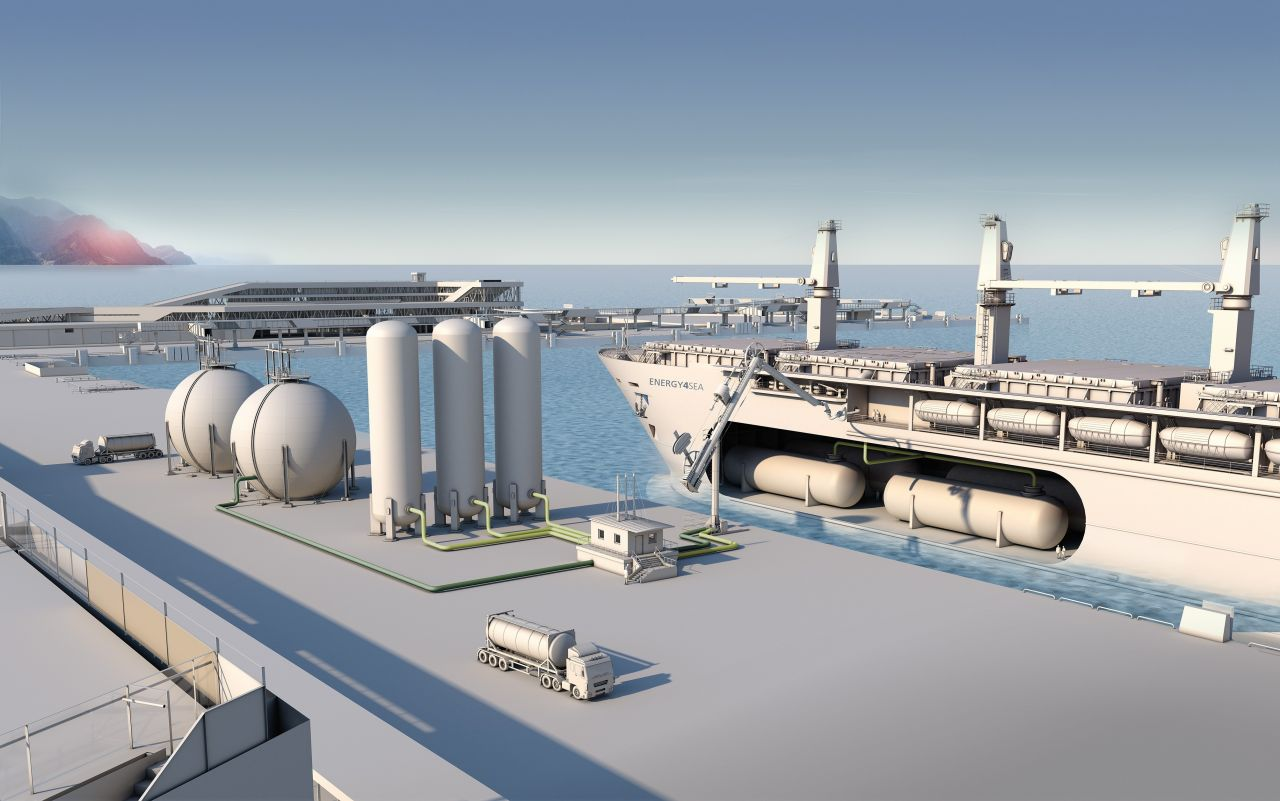
Photo credit: DLR, CC BY-NC-ND 3.0
1st October 2026
How can liquid hydrogen (LH₂) be transferred to ships safely, efficiently and with as little loss as possible? A new research facility for the bunkering of liquid hydrogen, which is being developed and built by Marine Service GmbH, is dedicated to addressing this question.
In September 2026, the German Aerospace Centre (DLR) commissioned Marine Service GmbH to develop and supply an LH₂ bunkering system for the Institute of Maritime Technologies and Propulsion Systems. The facility is one of the first research facilities of its kind in the world and will provide important insights into safe, efficient and cost-effective bunkering processes using liquid hydrogen.
The facility will enable transfer rates of up to 500 kilograms of liquid hydrogen per hour and will be equipped with extensive sensor technology, its own automation and SCADA system, and an infrastructure fully housed within a containment structure. This will enable all operational and process data to be recorded, visualised and analysed for research purposes.
The aim is to investigate the entire bunkering process under real-world conditions, to model it digitally and to optimise it continuously. Particular emphasis is placed on combining experimental research with digital simulation models. The data obtained enables models to be validated and the behaviour of the entire system to be accurately represented.
A key area of investigation is so-called boil-off losses. As liquid hydrogen is stored and transported at extremely low temperatures, heat input during transfer can lead to evaporation. The research facility is intended to help better understand the causes of these losses and to develop measures to reduce them.
Furthermore, the facility offers the opportunity to investigate other safety-related processes, such as the inerting of pipes and systems. At the same time, it will be used in future to train crews and specialist staff in the safe handling of liquid hydrogen under realistic conditions.
This research infrastructure will, for the first time, enable a comprehensive investigation of the transfer of liquid hydrogen. The aim is to develop safe, efficient and cost-effective bunkering processes, thereby laying important foundations for the future use of liquid hydrogen as an energy carrier or cargo in the shipping industry.
Delivery of the facility is scheduled to take place within 23 months after contract award. Marine Service GmbH looks forward to working with the DLR to make a significant contribution to the further development of the maritime hydrogen economy.